



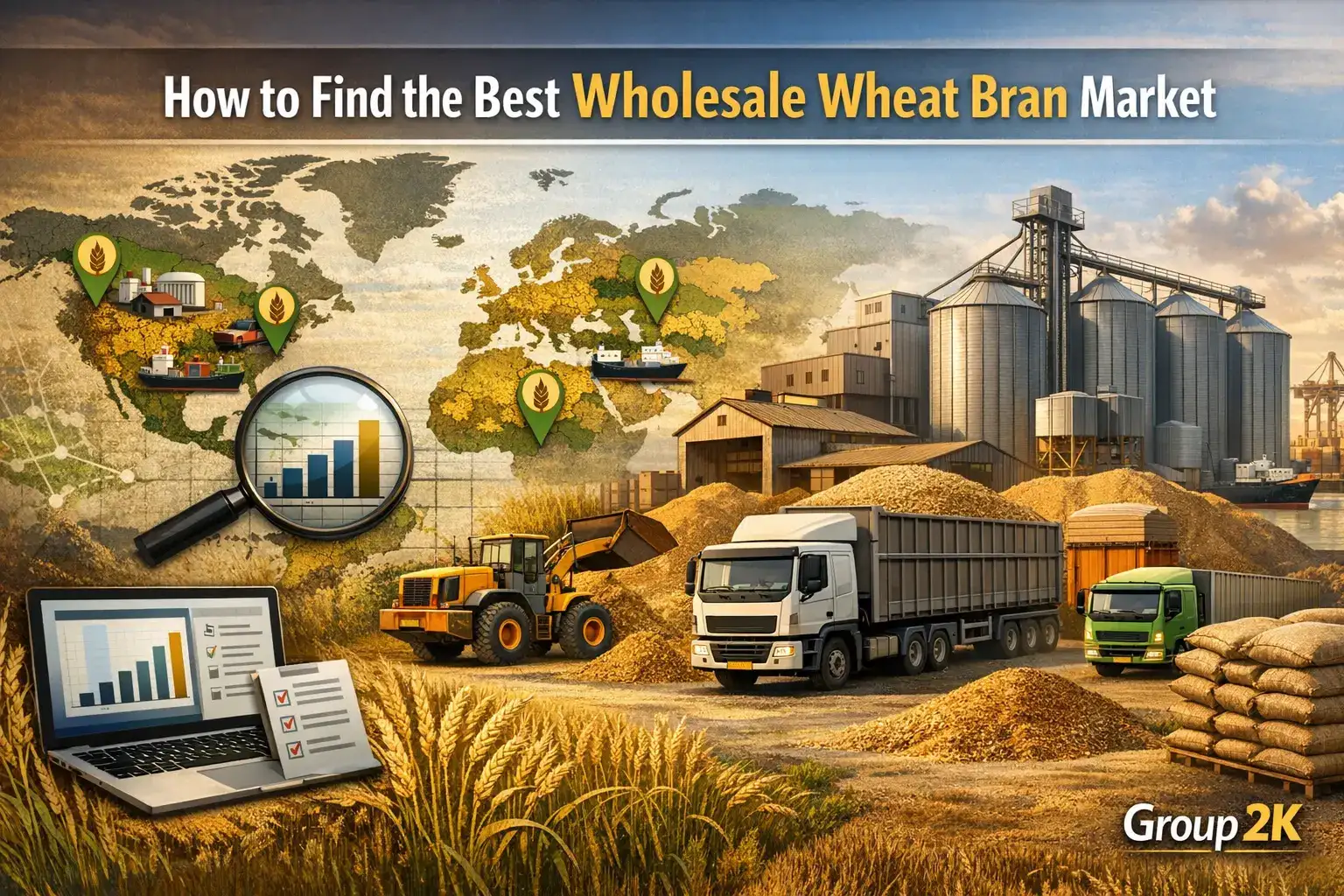
Wheat bran is the outer layer of the wheat kernel that remains after the milling process. Flour mills separate bran when they process wheat into flour. This bran is widely used in animal feed, poultry feed, dairy farming, aquaculture, and sometimes in health food products. If your business depends on bulk wheat bran, you must find the right wholesale market, not just a single seller. A strong market gives you stable supply, fair price movement, easy transport, and long term growth opportunities.
To succeed in this sector, buyers need a deep understanding of the global supply chain and procurement standards. Accessing a comprehensive resource for wholesale wheat bran buyers helps in navigating market complexities and ensuring quality standards are met across different regions. This broader perspective is essential for making informed purchasing decisions in the international trade arena.
How to Find the Best Wholesale Wheat Bran Market for Your Business starts with understanding where wheat production is high, where flour milling clusters operate, and where animal feed demand is strong. A market is a region, city, port, or trading hub where bulk buying and selling activity happens daily. When you choose the right market, you reduce risk, lower logistics cost, and improve profit margins. This guide explains how to identify active wholesale wheat bran markets using both online research and ground level study.
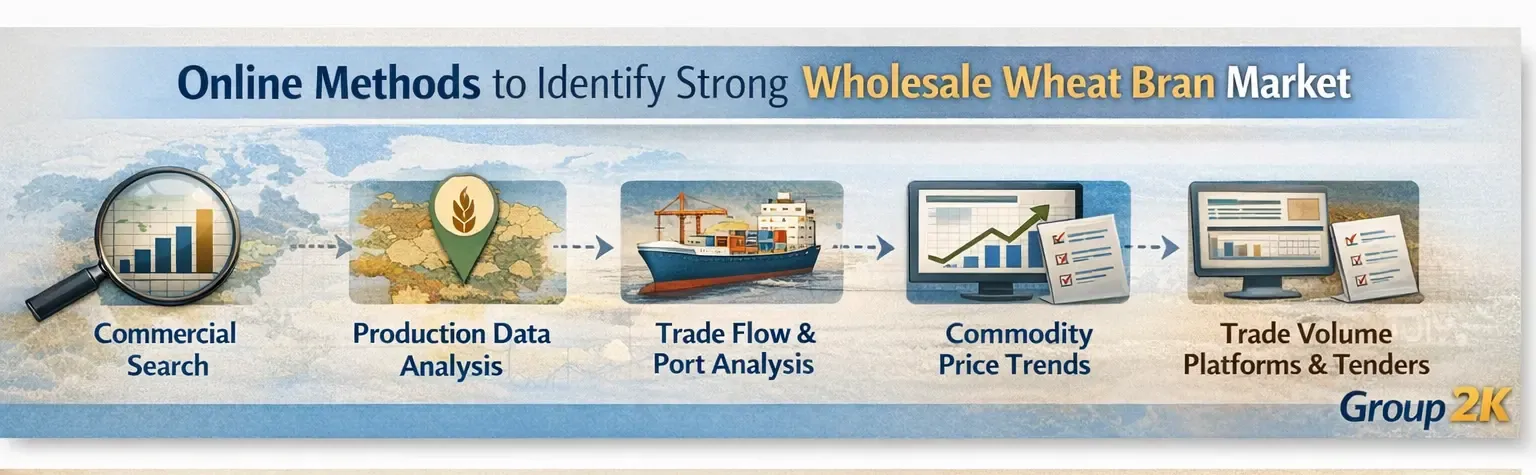
Online research helps you see the bigger picture. You can study wheat production data, export flow, price trends, and port activity without leaving your office. A serious B2B buyer studies production regions, livestock demand areas, and shipping routes before making any bulk decision.
Wheat bran supply directly depends on wheat milling. Countries with high wheat production usually have strong flour milling industries. When milling activity is high, bran output is also high. At the same time, regions with strong dairy and poultry sectors create heavy demand for bran in feed formulas.
Below are detailed online methods that help you identify strong wholesale wheat bran markets.
Commercial search engines like Google are not just for finding individual suppliers. They can be a powerful tool to understand which regions are active in wheat bran trade. The idea is to look for regional clusters, not single companies. Clusters are areas where multiple mills, warehouses, and buyers interact, creating a strong wholesale market.
To start, use region-focused search terms instead of generic product names. For example, type phrases like:
Repeat these searches for different countries and states. While reviewing results, look for patterns. If certain cities or regions appear multiple times, it indicates that these areas have high trading activity. For example:
The key factor is density. A strong market has many mills, storage warehouses, and transport facilities within the same region. Avoid regions where only a single listing appears, as that usually does not indicate a true trading hub.
When you identify these regions using commercial search, you are essentially mapping out potential wholesale wheat bran markets. You can then narrow your focus to regions where:
By following this approach, buyers do not just find suppliers, they discover entire markets where wheat bran trade is active, stable, and scalable for bulk business.
One of the most important ways to identify a strong wholesale wheat bran market is by studying wheat production data. Wheat bran is a byproduct of flour milling, so regions that grow large quantities of wheat usually have active milling industries. More wheat production leads to more flour processing, and that automatically increases wheat bran availability. Understanding production levels helps buyers know which regions are likely to have a stable and high-volume wholesale market.
Globally, countries like China, India, Russia, United States, and France produce the largest volumes of wheat. These countries also have strong flour milling industries. If you focus on these regions, you are more likely to find wholesale wheat bran markets with multiple suppliers, bulk availability, and consistent trade activity.
Within each country, certain states or provinces dominate wheat production. For example:
By analyzing state or regional data, a buyer can pinpoint trading hubs instead of randomly contacting suppliers. These regions often have multiple flour mills located close to each other, creating a natural cluster for wheat bran trade.
You should focus on three key points when using production data to find wholesale markets:
By combining these insights, buyers can identify markets where wheat bran supply is consistent, large-scale, and cost-effective. Instead of focusing on individual suppliers, look at the overall production and milling clusters in a region to understand where a strong wholesale market exists.
Understanding import and export trade flow is one of the most important steps in finding an active wholesale wheat bran market. Trade flow tells you where wheat bran moves in bulk, which regions are exporting heavily, and which regions are importing to meet local demand. This information helps a buyer identify strong markets rather than individual suppliers.
Some countries produce surplus wheat bran because their wheat milling industry is large. These countries export bran to international buyers, creating active wholesale markets around their ports. On the other hand, countries with high livestock, poultry, or dairy industries often import bran to meet feed demand. For example, many Middle Eastern countries rely on imported wheat bran due to limited local wheat production. Similarly, parts of Asia and Africa with growing poultry and livestock sectors import bran regularly to feed their animals.
To analyze trade flow, a buyer should study official export and import data. Key points to look for include:
For a B2B buyer, regions that export wheat bran consistently and in large volumes usually indicate strong wholesale markets. These markets often have good infrastructure, established milling clusters, and reliable logistics, which makes sourcing easier and safer. Observing trade flow patterns over time also helps a buyer predict seasonal supply, plan purchases, and avoid regions with unstable output or irregular shipments.
Ports are a key indicator of active wholesale wheat bran markets. Large quantities of bran move through well-equipped ports, linking producing regions to consuming regions. Observing port activity reveals not just export capacity, but also the presence of milling clusters and trading hubs nearby.
Key points to analyze:
Practical tip: Monitor daily truck, rail, and container flow. Continuous high-volume movement signals a strong wholesale market, not just production. Regions like Gulf Coast ports (USA), Black Sea ports (Russia/Ukraine), or major Indian ports with dense milling clusters nearby are prime examples.
Identifying dense milling and feed clusters is essential to locate active wholesale wheat bran markets. These clusters indicate consistent production and strong demand.
Tools to map clusters:
Cluster indicators:
Regions like Punjab (India/Pakistan), Kansas (USA), and Central Anatolia (Turkey) demonstrate high-density clusters. Dense clusters ensure continuous wheat bran production, active trading, and better pricing for bulk buyers.
Studying wheat bran price trends online is one of the easiest ways to understand which regions have active and stable wholesale markets. Price does not just tell you the cost; it shows supply strength, demand pressure, and market activity. When a region has many buyers and sellers, prices move in predictable patterns. Unusual price spikes or sudden drops can indicate temporary shortages, transportation issues, or high local demand.
Wheat bran prices are affected by multiple factors:
Buyers can track monthly or weekly commodity price updates from online trade platforms, government agriculture reports, or industry portals. Compare prices across different months, especially between harvest and off-season periods.
By analyzing price trends, a buyer can:
Studying price trends does not only help in choosing a market; it also allows buyers to negotiate better deals, time purchases for lower costs, and find wholesale hubs where supply meets demand efficiently.
To identify the best wholesale wheat bran market, it is important to study industry news and agriculture reports. These reports provide insight into wheat production, regional crop conditions, and factors that affect supply. Wheat bran comes directly from wheat milling, so the amount of wheat produced in a region determines the available bran supply. If a region’s wheat crop is healthy and abundant, it is likely that flour mills there will have a steady output of bran, making it a strong wholesale market. On the other hand, if wheat production is low due to drought, flooding, pest attacks, or disease, bran output may drop and market prices may rise.
Government agriculture departments, research agencies, and global organizations regularly publish crop reports. These reports often include:
By studying these reports, a buyer can identify which regions are likely to have consistent wheat bran supply, and which areas may experience shortages. Monitoring crop updates and seasonal news helps you anticipate price trends and select wholesale markets where supply is stable and reliable.
This method allows you to focus on regions with strong production and stable supply, rather than randomly contacting individual suppliers. It gives a clear view of the market strength before making bulk purchasing decisions.
Trade volume data platforms are specialized online tools that track the movement of bulk commodities like wheat bran between regions and countries. These platforms record shipments, including the quantity exported, destination country, port of loading, and shipment frequency. For a B2B buyer, these platforms are extremely useful because they help identify active markets, not just individual suppliers.
By analyzing trade volume data, you can understand which regions or countries consistently produce and export wheat bran in large quantities. A market with growing or stable shipment volumes year after year indicates reliable production, steady demand, and active trading hubs. Conversely, regions with declining export activity may face production challenges, local shortages, or policy restrictions, signaling higher risk for buyers.
Key factors to focus on when using trade volume platforms:
By carefully studying these metrics, you can map the best wholesale wheat bran markets, understand which regions offer consistent supply, and plan your purchasing strategy accordingly. Using this data, buyers can narrow their focus to the most active, stable, and profitable trading hubs.
Institutional buyers, such as government feed programs, large livestock farms, or cooperatives, often announce bulk purchase requirements for wheat bran. These notices are publicly available on official websites or dedicated tender platforms. Instead of focusing on individual suppliers, you can use these notices to identify which regions or markets have the highest demand.
Here is how to use tender and bulk purchase notices for market research:
Key Takeaway:
Tender and bulk purchase notices are not about contacting suppliers directly. Instead, they act as a signal of market strength, showing regions where wheat bran is in high demand. An area with multiple large tenders consistently indicates a robust wholesale wheat bran market, guiding buyers where to focus research and potential trade activity.
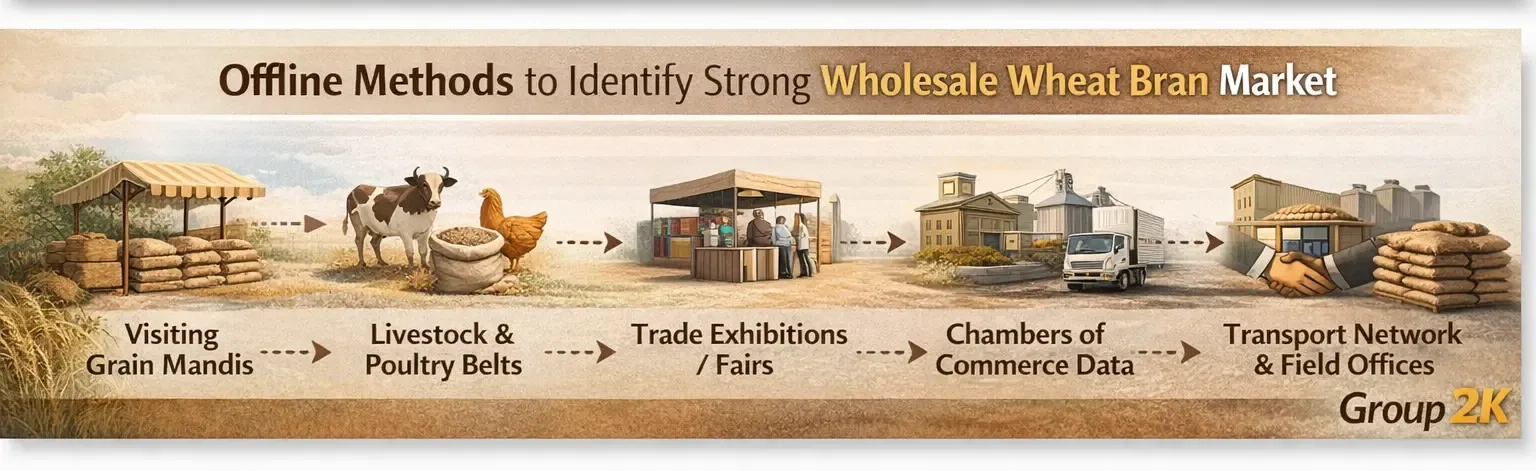
Online research gives you data. Offline study gives you real world understanding. Wheat bran quality depends on storage and handling. Physical markets show daily trading activity.
When you visit a region, observe how trucks move, how warehouses operate, and how traders negotiate prices. Real activity tells you more than online listings.
Grain mandis are traditional wholesale markets where farmers bring wheat for sale. These markets are not just for buying wheat, they also show the level of milling and bran trade activity in a region. By visiting a mandi, a buyer can see where wheat flows in bulk, which areas have active trading, and which regions produce consistent bran supply.
High wheat arrival at a mandi usually means nearby flour mills are buying wheat continuously. Since wheat milling produces bran as a byproduct, regular wheat inflow indicates that bran production is ongoing. This helps buyers understand which markets are active and reliable for wholesale wheat bran sourcing.
When visiting a mandi, observe the following carefully:
Additionally, notice the infrastructure of the mandi: loading areas, storage sheds, and transport vehicles. Well-organized mandis with efficient loading and unloading suggest that bulk trading is easier, which is critical for buyers planning large wheat bran purchases.
By studying mandis in this way, a buyer can identify the regions where wheat milling is strong, bran supply is consistent, and wholesale trade is active, making it easier to select the best markets for sourcing wheat bran.
Wheat bran is a key ingredient in animal feed. Its demand is directly linked to regions with high livestock, dairy, and poultry activities. If you want to identify the best wholesale wheat bran market, studying these regions gives a strong clue about where bulk trade happens regularly.
Start by mapping areas with concentrated livestock operations. Large dairy farms, commercial poultry farms, cattle farms, and feedlots usually consume massive amounts of wheat bran every month. A region with many such farms indicates strong and consistent demand. For example, states or provinces with dense poultry farming often maintain a stable feed supply chain, which in turn supports active wholesale wheat bran trading hubs nearby.
Observing livestock belts also helps you understand seasonal trends. Demand rises in areas before breeding seasons or winter months, creating temporary surges in bran consumption. By tracking these patterns, a buyer can pinpoint regions where the market is most active, pricing is competitive, and supply channels are reliable.
Connecting livestock density with nearby milling and storage hubs is essential. Markets located close to both large farms and flour mills often see high daily trading volumes of wheat bran. This creates strong price stability and reduces transportation risk.
In short, analyzing livestock and poultry belts allows a buyer to locate active wholesale wheat bran markets, anticipate demand trends, and identify regions that provide both supply reliability and cost efficiency.
Trade exhibitions and commodity fairs are important events where people from the wheat and feed industry gather. These events bring together grain traders, flour mill owners, feed producers, transporters, and sometimes government representatives. As a buyer, attending these fairs is not only about finding a supplier, it is about observing which regions have strong wheat bran trade activity.
When you walk through an exhibition, notice which states or countries have the most stalls or exhibitors. For example, if Punjab, India, or Kansas, USA, have many exhibitors, it indicates that these regions have high wheat production and strong milling activity, creating an active wholesale market. You can also see which regions send buyers or importers, which signals high demand clusters.
Besides observing numbers, pay attention to:
By analyzing this data, you can map out regions where wholesale wheat bran trade is strong, even before making any purchase. This method helps you identify high-volume, reliable markets rather than focusing on individual suppliers.
Chambers of commerce are official business organizations that keep records of all registered companies in a region. They include information about traders, exporters, and manufacturers. For a buyer searching for a wholesale wheat bran market, chambers of commerce can give important insights about which regions are actively involved in wheat and bran trade.
By analyzing their data, you can find out:
You can usually request industry reports or trade directories from local chambers. These reports show the concentration of businesses and trading activity. A region with many registered wheat and feed-related companies usually indicates a healthy, active market, where bulk buying and selling happen regularly.
This helps you focus your market search on areas with real trading activity, rather than random locations where wheat bran is produced but rarely traded in bulk.
When searching for the best wholesale wheat bran market, understanding the transport network is key. A strong market is not just about production; it is also about how easily bulk wheat bran moves from farms and mills to major trading hubs. Regions with good road, rail, and port connectivity usually host active and reliable wholesale markets, while poorly connected areas may have limited trade activity.
Key points to identify a market using transport analysis:
Summary: Transport network analysis helps buyers identify strong wholesale wheat bran markets, not individual suppliers. By studying road, rail, and port connectivity, you can determine which regions consistently support bulk trading and have the infrastructure to maintain high market activity.
Local agriculture department offices are a very useful resource for understanding where wheat production is strong. These offices regularly collect and publish crop yield reports, storage data, and regional production forecasts. For a buyer searching for the best wholesale wheat bran market, visiting or contacting these offices can provide insights that are hard to get online.
When you engage with agriculture department officials, ask about:
By combining this information, you can identify regions where bran supply is consistent, prices are competitive, and logistics are easier. Buyers can prioritize markets that have both high production and strong storage infrastructure to ensure smooth procurement.
Commission agents, often called middlemen, play a critical role in grain markets, including wheat bran trade. They have first-hand knowledge of daily trading activity, local prices, and supply-demand fluctuations. Unlike online data, which may show past trends or official reports, brokers provide real-time, on-ground information that helps buyers make faster decisions.
Using this information, you can prioritize Amritsar for stable supply and Patiala for future growth opportunities.
Commission agents are not just middlemen; they are market intelligence providers. Their knowledge helps identify active wholesale wheat bran hubs, predict price trends, and spot demand clusters. Always verify insights by talking to multiple brokers and cross-checking with other online and offline market data.
Local feed manufacturing clusters are areas where multiple feed mills, animal feed factories, and poultry feed producers operate close to each other. These clusters are very important for identifying strong wholesale wheat bran markets because they show where demand is consistently high.
Imagine a region with ten feed mills producing poultry and cattle feed. Each mill needs several tons of bran weekly. Suppliers in that area maintain large stock and schedule regular shipments. For a B2B buyer, this region represents a strong wholesale wheat bran market with stable supply, predictable pricing, and reliable logistics.
Choosing the best wholesale wheat bran market requires a balanced approach. First study wheat production data. High production supports strong milling activity. Strong milling creates bran supply. Then study livestock density and feed demand. Balanced supply and demand create stable markets.
Online research helps you identify production regions, export ports, and trade flow. Offline visits confirm storage quality, transport strength, and real trading activity. Combine both methods before making bulk decisions.
Select a market that offers:
Do not focus only on low price. A stable and well connected market gives long term business security.
Identifying a wholesale wheat bran market is only half the battle; the real challenge lies in securing a consistent and verified supply chain. Group 2k functions as a premier digital trade hub, consolidating high-quality output from major global milling clusters and production belts into one accessible platform. We eliminate the complexities of ground-level sourcing by providing you with direct access to a stable, large-scale supply that meets international feed and quality standards.
If you are looking for a reliable gateway to the world’s most active wheat bran trading hubs without the logistical hurdles, Group 2k is your strategic partner. Our platform offers the same market density and competitive pricing discussed in this guide, all within a streamlined B2B environment. Visit our Wholesale Wheat Bran Category today to connect with top-tier supply and align your bulk procurement with the most stable markets in the industry.
Every household on earth eventually replaces a refrigerator, a washing machine, or a hair styling
READ FULLConstruction and logistics both depend on wood products every single day, whether it is a structu
READ FULLHeating demand never truly disappears, and renewable fuel demand keeps climbing every year. Trade
READ FULL