



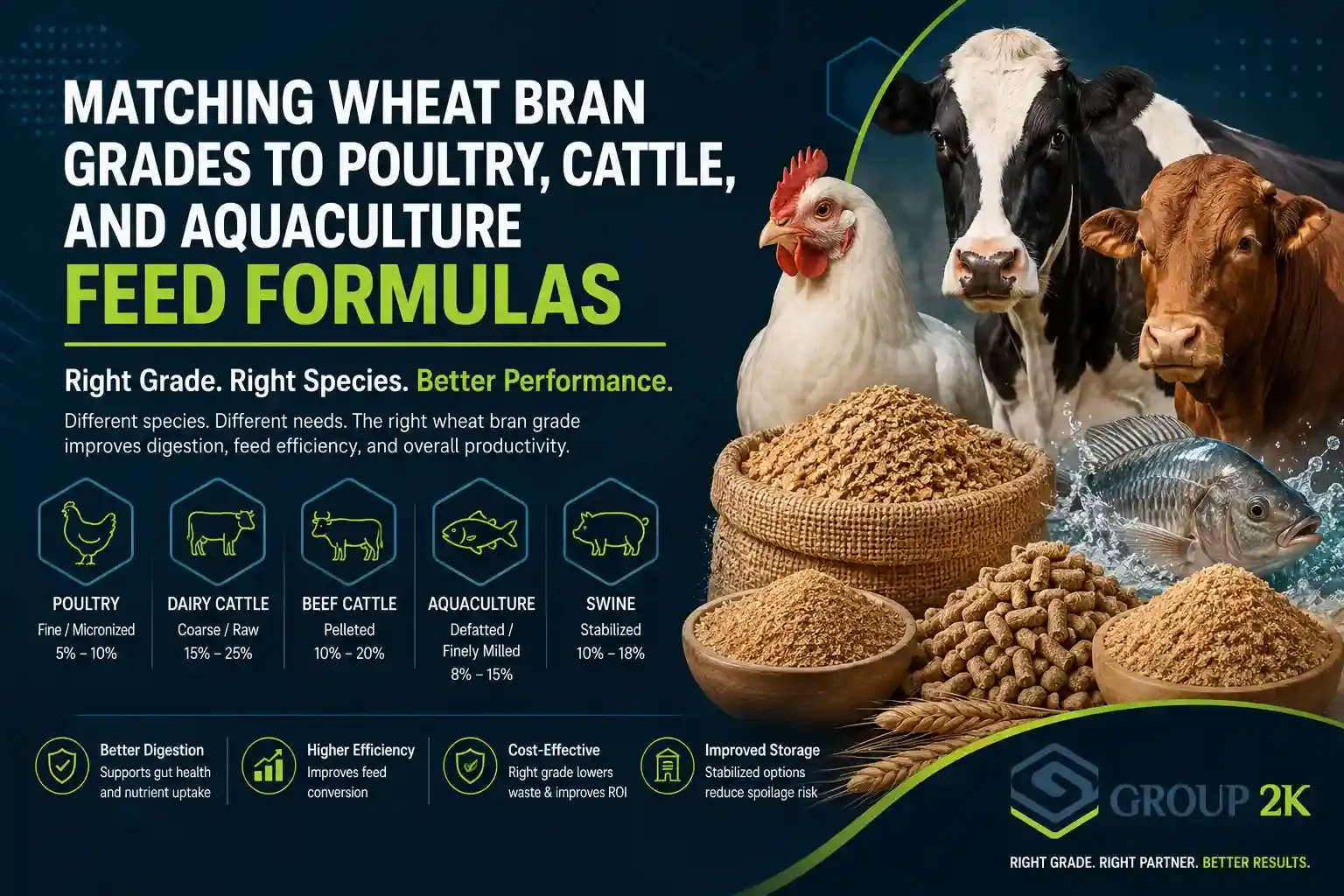
Not every batch of wheat bran belongs in every feed ration. A poultry formulator and a dairy nutritionist are often buying the same milling byproduct for completely different reasons, and the form of bran that works well in one ration can cause handling problems in another. Buyers who treat wheat bran as a single, interchangeable commodity frequently end up with a product that technically meets a moisture and protein spec on paper, but performs poorly once it reaches the mixer.
This guide breaks down how bran grade, particle size, and processing method should be matched to the species being fed, so that procurement decisions are made around feed performance, not just price per ton. If you are sourcing in bulk, understanding this match before you order helps you brief your wheat bran wholesale suppliers correctly the first time, instead of discovering a mismatch after the container has already landed.
Two batches of wheat bran can carry identical lab numbers for crude protein, moisture, and fiber, and still behave completely differently once they reach a feed mill. The variable that often gets overlooked is physical form. Whether the bran is raw, micronized, pelleted, or stabilized changes how it mixes, how it digests, and how long it survives in storage before a feed mill is even ready to use it.
A feed wheat supplier who understands this will ask what species the bran is going to before quoting a price, because the right answer changes the recommended particle size, the packaging, and sometimes the moisture target as well.
The table below is a starting point for sourcing conversations, not a substitute for a full ration formulation done by a qualified nutritionist. Inclusion rates vary by region, by the rest of the ration, and by the specific production goals of the operation.
|
Livestock Category |
Recommended Bran Form |
Typical Inclusion Rate |
Why It Works |
|
Poultry (broilers & layers) |
Fine or micronized bran |
5% to 10% of total ration |
Fine particles blend evenly into pelleted feed without clogging mixers |
|
Dairy cattle |
Coarse or raw bran |
15% to 25% of total ration |
Coarse fiber slows rumen passage and supports steady milk fat output |
|
Beef cattle / feedlot |
Pelleted bran |
10% to 20% of total ration |
Pellets reduce sorting and dust loss in bulk feeding troughs |
|
Aquaculture (carp, tilapia) |
Defatted, finely milled bran |
8% to 15% of feed mix |
Low oil content limits water fouling and rancidity in floating feed |
|
Swine (grower-finisher) |
Stabilized bran |
10% to 18% of total ration |
Stabilization prevents rancidity during the longer storage cycles common in swine operations |
Poultry rations are usually pelleted, and pellet mills do not handle coarse, flaky bran well. Large flakes resist compression, leave gaps in the pellet structure, and increase pellet fines during transport. Fine or micronized bran compresses more evenly, which is why most commercial poultry formulators specify a finer grade even though it costs slightly more to produce.
For layers in particular, fiber from bran also supports gut health and can help manage egg size consistency over a long laying cycle. This is one reason layer feed often carries a higher bran inclusion than broiler starter feed.
Cattle rations work differently. The rumen needs effective fiber, meaning fiber particles large enough to stimulate chewing and slow the passage of feed. This is exactly where coarse, raw wheat bran performs better than the finely milled grades preferred in poultry feed. Grinding cattle bound bran too fine can actually reduce its functional value in the ration, even though the chemical fiber percentage on the lab sheet stays the same.
Feedlot operations that buy in pelleted form are usually optimizing for handling and dust control in bulk feeding systems rather than for fiber length, so the choice between raw and pelleted bran for cattle often comes down to the buyer's own feed handling equipment rather than the animal's nutritional requirement.
Floating and sinking aqua feeds behave very differently in water than dry feed sitting in a trough, and wheat bran's natural oil content is a much bigger factor here than in terrestrial livestock feed. Bran with higher residual oil content can go rancid faster once incorporated into pellets, and rancid oil affects both palatability and water quality in pond systems.
This is why defatted or stabilized bran is typically the safer specification for aqua feed manufacturers, even at a modest premium over raw bran. Buyers sourcing for this segment should confirm oil content explicitly, since standard wheat bran specification sheets often report protein, fiber, and moisture, but not always residual fat.
Swine operations frequently hold larger on site inventories of feed ingredients than poultry operations, simply because of how grower-finisher cycles are scheduled. That longer storage window makes rancidity and mold risk more relevant, which is why stabilized bran, treated specifically to slow oxidation, tends to be the preferred specification for this segment, particularly in warmer climates.
A short, specific brief at the quoting stage avoids most of the mismatches described above. At minimum, share:
Once the right form is identified, the sourcing process is the same as for any other bulk agricultural ingredient. Confirm specification sheets, request a sample batch, and verify that the grade quoted matches what is actually loaded into the container. Group 2K works with wheat bran wholesale suppliers across multiple grades and can help match the right form to your specific feed application before you commit to a bulk order.
Every household on earth eventually replaces a refrigerator, a washing machine, or a hair styling
READ FULLA structural panel and a warehouse pallet come from the same raw material, yet they serve two com
READ FULLCold-climate households still need heat, and power plants across Europe and Asia still need renew
READ FULL