



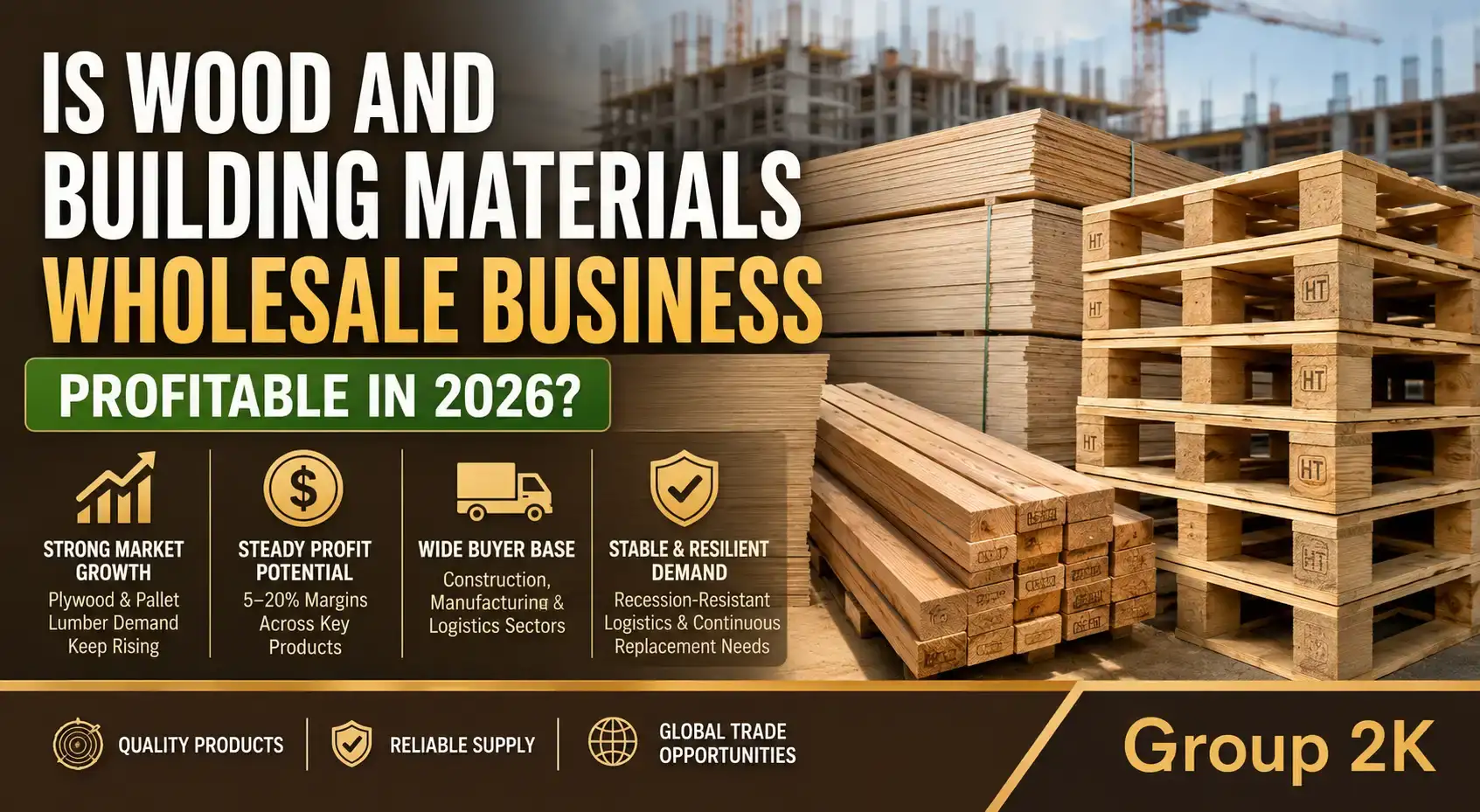
Construction and logistics both depend on wood products every single day, whether it is a structural panel or a warehouse pallet. Traders researching building materials wholesale trading in 2026 are entering a sector tied directly to global construction activity and supply chain infrastructure. This guide breaks down real market data, margin expectations, and the specific products driving demand in bulk wood and building material trade.
Wood-based building materials serve two very different industries at once. Construction firms depend on panel products for structural and finishing work, while logistics and manufacturing companies depend on wood packaging to move goods through global supply chains. This dual demand base gives the category a broader buyer pool than most single-purpose commodities, since a slowdown in construction rarely affects freight and logistics demand at the same time. Strong volume potential paired with tighter per-unit margins is a pattern worth measuring against other sectors before committing capital, which is exactly what our wholesale business profitability guide sets out to do.
Plywood shows exceptionally strong growth heading into 2026. The global plywood market is estimated at $70.12 billion in 2026 and is projected to expand at a 6.9% compound annual growth rate, reaching $111.86 billion by 2033. A separate industry estimate places the market even higher, at $131.63 billion in 2025, growing toward $173.48 billion by 2030 at a 5.8% annual rate. Both figures point toward the same underlying driver. Surging construction activity worldwide continues pushing plywood demand higher year after year.
Wood pallets show a comparable growth trajectory in the logistics and packaging segment. The global wood pallets market was valued at $14.61 billion in 2025 and is projected to grow from $15.28 billion in 2026 to $21.87 billion by 2034, a 4.58% compound annual growth rate. Asia Pacific alone commands close to 40% of this global market share, driven by rapid industrialization and expanding manufacturing output across the region.
Plywood benefits from two reinforcing trends happening at the same time. Rising urbanization and growing disposable income in emerging economies continue pushing construction activity higher, while furniture manufacturing and interior decoration industries add further demand on top of pure construction use. This combination keeps plywood demand diversified across residential, commercial, and industrial buyers simultaneously.
Wood pallets depend on a different but equally durable demand driver. Continuous pallet circulation across warehouses and distribution hubs creates constant replacement demand, since pallets wear out through repeated handling and shipping cycles. Growth in the food and beverage industry, expanding e-commerce fulfillment networks, and rising international trade volume all add pressure to this replacement cycle, keeping wholesale pallet lumber in steady demand.
Margins in this category vary significantly depending on the specific product and processing level involved. Pallet-focused businesses in particular operate on notably tighter margins than other wood products, with typical profit margins ranging from 5% to 10% due to intense price competition in the sector. Lumber price fluctuation adds direct pressure to these margins, since raw material cost swings can quickly erode profitability if not managed through bulk purchasing or longer-term supply contracts.
| Investment Level | Typical Entry Point | Common Products |
|---|---|---|
| Small trader | Partial container, mixed grade lumber | Pallet lumber boards |
| Mid-size distributor | Full container loads | Plywood sheets, bulk pallet lumber |
| Bulk exporter | Multi-container contracts | Construction-grade plywood |
Traders who lock in longer-term supply agreements or purchase raw lumber in bulk during favorable pricing windows tend to protect their margins more effectively than those buying reactively on the spot market.
Building material demand centers heavily on structural and finishing wood panels, and plywood leads this category by volume. Construction firms depend on it for framing, subflooring, and formwork applications, while furniture manufacturers rely on it for cabinet-grade panel construction. Buyers sourcing bulk volume typically request high-strength plywood sheets with verified grading and moisture resistance, since inconsistent panel quality directly affects structural performance on construction sites.
Softwood plywood currently dominates global market share, reflecting its cost-effectiveness for large-scale construction projects, while hardwood variants continue serving premium furniture and interior design applications where appearance and durability both matter to the buyer.
Pallets and wood materials supply an entirely different buyer segment centered on logistics, warehousing, and freight movement rather than construction. Manufacturers, distributors, and freight companies all depend on this product to keep goods moving safely through global supply chains, making it one of the most consistently reordered wood products in the entire building materials category.
Buyers sourcing pallet lumber in bulk generally request durable construction-grade pallet lumber with consistent board thickness and load-bearing strength, since pallets that fail under weight create safety hazards and costly product damage during transit. Continuous replacement demand from warehouses and distribution centers keeps this segment moving steadily, regardless of broader construction market cycles.
Lumber price volatility represents the most direct risk across this entire category, since raw timber cost fluctuations flow straight into production cost for both plywood and pallet lumber. Competition from alternative materials adds a second layer of risk, particularly for pallets, where plastic and metal alternatives offer durability advantages even though wood remains the dominant choice due to lower cost and easier repairability.
Regulatory compliance presents an ongoing challenge as well, since international trade increasingly requires strict phytosanitary standards for wood packaging materials crossing borders. Labor availability affects processing capacity directly, as the pallet manufacturing segment in particular faces persistent workforce shortages that can constrain supply during periods of high demand. Sustainable forestry certification is also becoming a stronger buyer requirement, especially among large industrial and retail customers focused on supply chain sustainability commitments.
Wood and building material wholesale trading suits traders who can manage tighter margins through strong operational efficiency. New entrants with moderate capital often start with pallet lumber, since replacement demand from logistics networks provides consistent, predictable order volume. Distributors already serving construction supply chains frequently add plywood to their existing product range, since buyer relationships in that space translate directly into new demand. Established exporters with strong freight and phytosanitary documentation capabilities tend to focus on plywood, where premium construction-grade product commands stronger per-unit margins than commoditized pallet lumber.
| Category | Typical Margin Range | Demand Trend | Risk Level |
|---|---|---|---|
| Plywood | 10-20% | Strong, construction-driven | Medium |
| Pallet lumber | 5-10% | Stable, replacement-driven | Medium |
A few checks separate a dependable wood products supplier from a costly mistake. Grading and moisture levels come first, since these factors directly determine structural performance for construction buyers and get flagged fast if wrong. Delivery reliability matters just as much, because both construction firms and logistics companies plan operations around predictable schedules and cannot absorb sudden gaps. International standards for wood packaging keep tightening, so phytosanitary and export documentation experience is worth confirming upfront rather than discovering a problem at customs. Given how tight price competition already runs in this category, factory-direct pricing is often the difference between a healthy margin and a break-even shipment.
Plywood and pallet lumber pull profit from two different directions. One rides the strength of global construction growth across residential, commercial, and furniture demand. The other holds steady on recession-resistant freight replacement volume that barely notices construction slowdowns. Traders who stay on top of lumber cost swings, grading consistency, and export paperwork are the ones who turn that combination into dependable margin rather than a race to the bottom on price.
Verified structural panel strength, precise thickness tolerances, and proper moisture-grade checks are absolutely non-negotiable to maintain commercial buyer trust in building material distribution. Group 2K company guarantees consistent mill grading systems and container-ready export logistics for the global construction and industrial supply chain sectors alike. We work directly with leading processing mills to secure premium timber materials, allowing your company to bypass secondary broker markups and maintain highly competitive local pricing.
Our timber shipping experts handle all phytosanitary heat treatments and documentation required to clear strict customs barriers without costly warehouse demurrage penalties. Whether your current trade channels require high-strength softwood plywood for massive building projects or durable pallet boards for logistics networks, we fulfill bulk orders with absolute dimensional consistency. You can review our industrial wood and building materials sourcing capabilities to match your current inventory metrics. Contact us to initiate your freight booking.
Every household on earth eventually replaces a refrigerator, a washing machine, or a hair styling
READ FULLConstruction and logistics both depend on wood products every single day, whether it is a structu
READ FULLHeating demand never truly disappears, and renewable fuel demand keeps climbing every year. Trade
READ FULL