



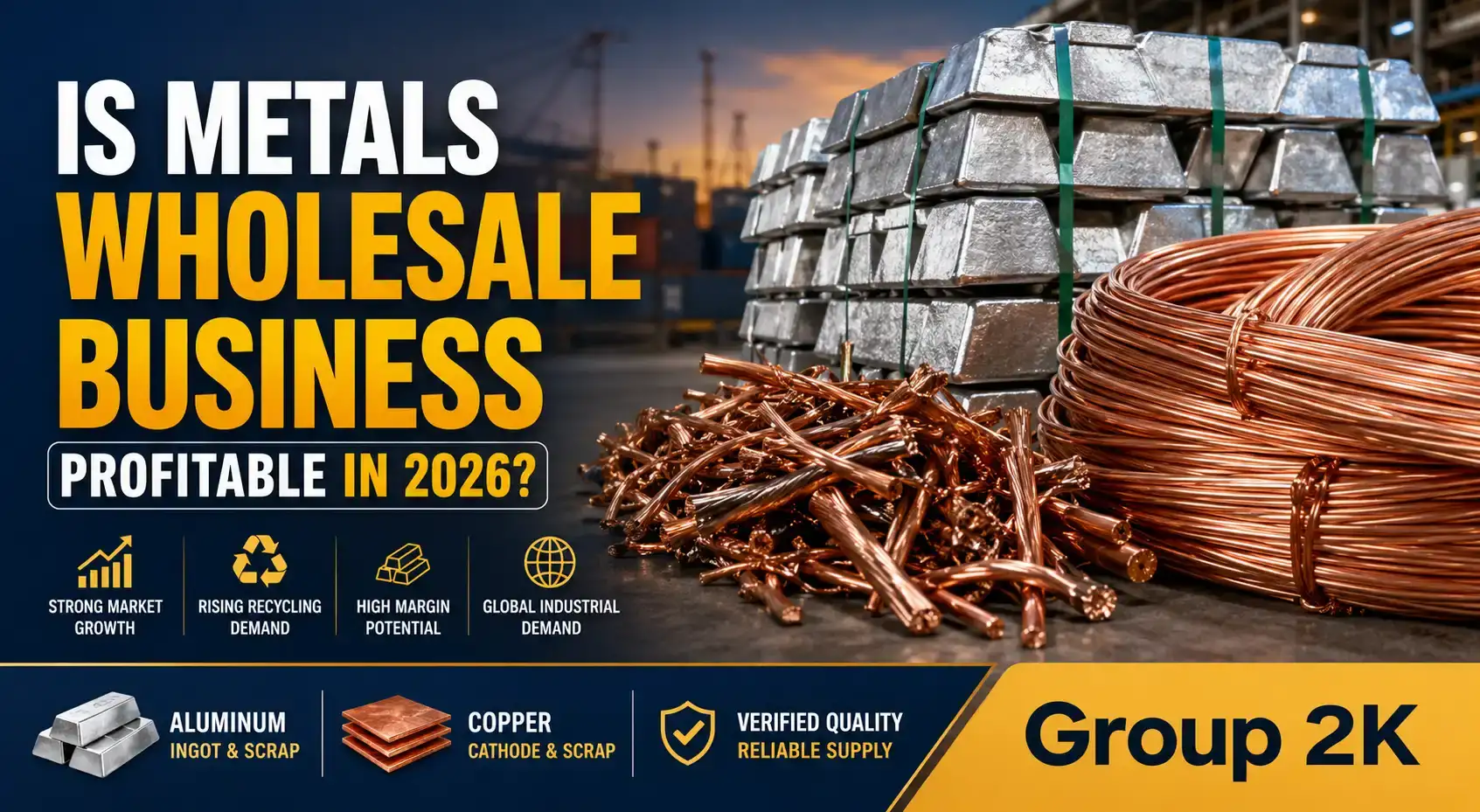
Copper and aluminum move global manufacturing more than almost any other raw material, and that alone pulls new traders toward metals wholesale every year. Anyone weighing this sector against food, agriculture, or wood should first look at our wholesale business profitability comparison for 2026, which lines up six major sectors side by side before diving into any one of them in detail.
This guide focuses purely on metals. It covers current market size for copper and aluminum scrap, how pricing has shifted through early 2026, the margin structure across ingot, cathode, and scrap grades, and the specific risk factors a metals trader needs to manage. The goal is a clear, data-backed answer, not a generic sales pitch.
Metals trading rewards traders who track pricing closely and act fast, and this article breaks down exactly where that speed pays off.
The scrap and recycled metals segment shows some of the strongest growth numbers in the entire metals trade. The global copper scrap market is projected to grow from $73.90 billion in 2026 to $114.97 billion by 2034, reflecting a 5.7% compound annual growth rate. A separate industry estimate places the copper scrap market at $42.4 billion in 2026, expanding toward $78.9 billion by 2033 at a 9.3% annual growth rate.
Aluminum scrap shows a comparable trajectory. The global aluminum scrap market is projected to grow from $56.77 billion in 2026 to $91.49 billion by 2034, a compound annual growth rate of 6.1% across that period. The wider scrap metal recycling market, which covers copper, aluminum, and other non-ferrous metals together, stood at 567.98 million tons in 2026 and is expected to reach 764.39 million tons by 2031.
Recycled and secondary metal supply is becoming the backbone of global manufacturing, not a side market. Manufacturers increasingly prefer recycled copper and aluminum to lower their carbon footprint and reduce dependence on newly mined ore, and this preference pushes scrap demand higher every year.
Metal pricing moved in an unusual direction during early 2026. Procurement teams at major manufacturers began shifting significant order volume from copper cathode toward aluminum ingot, as the price ratio between the two metals widened past historical norms. This shift benefited aluminum producers directly, while copper buyers faced tighter competition for available supply.
Aluminum ingot pricing itself has shown mixed regional movement. Early 2026 brought a downward trend in some markets due to ample supply and softer demand from manufacturing and construction, while other regions saw steady upward pressure from strong automotive demand paired with tighter production controls. This regional divergence creates arbitrage opportunity for traders who can source in a low-price region and sell into a high-demand one.
Metal trading margins depend heavily on grade, purity, and whether the product is scrap or refined ingot form. Non-ferrous metals such as copper generally command stronger returns than other scrap categories, since copper’s conductivity and scarcity keep buyer demand consistently high. Industry analysts note that scrap metal remains a profitable business when purchase costs, processing efficiency, and selling prices stay properly balanced, and profitability often depends more on operational discipline than on the raw material itself.
| Investment Level | Typical Entry Point | Common Products |
|---|---|---|
| Small trader | Partial container, mixed grades | Copper wire scrap, aluminum scrap |
| Mid-size distributor | Full container loads | Aluminum ingot, copper cathode |
| Bulk exporter | Multi-container or vessel contracts | High-purity ingot and cathode |
Metal trading carries a faster cash cycle than many other wholesale sectors, since buyers in manufacturing and construction typically operate on tight production schedules and cannot afford long procurement delays. This keeps capital turning over quickly for traders who maintain reliable supply relationships.
Aluminum sits at the center of two separate manufacturing trends right now. Automotive makers use it heavily in structural components and EV battery enclosures, while construction firms rely on it for extrusions, facades, and roofing. Both industries are expanding their aluminum consumption at the same time, which keeps demand strong across multiple buyer segments simultaneously.
Refined ingot supplies this demand at the highest purity level. Manufacturers sourcing high-purity aluminum ingot typically need it for precision casting and extrusion work, where impurities can compromise product quality. Buyers with less stringent purity requirements often turn to secondary supply instead.
Scrap aluminum fills that secondary demand efficiently. Because aluminum resists corrosion and holds its value even when stored outdoors, recyclers can accumulate large volumes before selling. This makes bulk aluminum scrap one of the most consistently traded materials in the entire non-ferrous scrap category, since it feeds directly into secondary smelting operations at a lower cost than primary ingot.
Copper trading operates on a different demand structure than aluminum. Electrical and electronics manufacturing depend on copper’s conductivity in ways that few substitute materials can match, which keeps baseline demand extremely stable even during broader industrial slowdowns.
Electrolytic copper cathode represents the highest-purity form of this metal available in bulk trade. Industrial buyers request high-purity copper cathode for wire drawing, electrical component manufacturing, and other applications where conductivity performance cannot be compromised.
Recycled copper supply plays an equally important role in this market. OEMs, utilities, and electronics manufacturers increasingly seek recycled copper specifically to reduce their supply chain emissions and strengthen sustainability reporting. This trend has made copper wire scrap a fast-growing segment, since wire scrap offers high copper content recovery with relatively straightforward processing compared to mixed-grade scrap.
Metal trading carries a distinct set of risks compared to agricultural commodities. Price volatility sits at the top of this list, since copper and aluminum prices move directly with refined metal benchmarks and can shift significantly within a single trading week. Scrap availability adds a second layer of risk, since collection volumes fluctuate with industrial output and construction activity, creating inconsistent feedstock supply for traders who depend on steady sourcing.
Trade policy adds further complexity. Export and import restrictions, inspection requirements, and shifting scrap trade rules can disrupt cross-border flows with little warning, particularly for mixed or lower-grade scrap that depends on established processing routes. Grade and purity verification present an ongoing operational challenge as well, since buyers pay a premium for consistent quality and penalize suppliers who deliver inconsistent material. Traders who build strong relationships with verified sourcing networks, rather than chasing the lowest price on any single shipment, tend to protect their margins more effectively over time.
Metals wholesale trading suits traders who can tolerate faster price movement than agricultural commodities typically show. New entrants often begin with smaller scrap volumes, since this requires less upfront capital than full container loads of refined ingot or cathode. Distributors already operating in construction or manufacturing supply chains frequently add metals to their existing product range, since their buyer relationships translate directly into new demand. Established exporters with strong logistics and quality verification systems tend to focus on high-purity ingot and cathode, where buyer trust commands a stronger price premium.
| Category | Typical Margin Range | Demand Trend | Risk Level |
|---|---|---|---|
| Aluminum ingot | 8-15% | Stable, automotive and construction driven | Medium |
| Aluminum scrap | 10-20% | Growing, recycling-driven | Medium |
| Copper cathode | 6-12% | Stable, electronics driven | Medium-High |
| Copper wire scrap | 12-22% | Growing, ESG-driven | Medium-High |
Metal buyers cannot afford to guess on purity or paperwork. Grade verification comes first, since purity claims directly affect the price a buyer can command downstream, and independent assay reports carry far more weight than a supplier’s own word. Supply consistency matters just as much, because manufacturers cannot absorb production delays caused by inconsistent material availability.
Scrap shipments in particular face stricter customs inspection than refined ingot, so a supplier with strong export documentation experience saves real time at the border. Factory-direct pricing keeps margin in the trader’s pocket rather than losing it to layers of unnecessary intermediaries.
The global metals trade in 2026 presents real profit opportunity for distributors and exporters who move fast on fast-moving trends. Recycled and secondary metals lead the growth story here, with copper and aluminum scrap both posting compound annual growth rates well above general commodity averages, driven directly by manufacturing sustainability targets rather than a temporary trend. Industrial buyers continue placing steady orders for high-purity ingot and cathode too, so the refined side of this market has not lost relevance even as scrap volumes climb.
Success in metals trading comes down to operational discipline more than raw material access. Traders need to watch benchmark price swings, plan around inconsistent scrap collection volumes, and stay ahead of shifting import and export rules that can close a route without warning. Regional price gaps between low-supply and high-demand markets create genuine arbitrage opportunity for traders who can move quickly and verify purity through independent assay reports rather than taking a supplier’s word at face value.
Sourcing high-purity ingots or bulk scrap shipments requires verified factory-direct pricing and clean international customs clearance. A minor documentation error or an unverified metal grade can cause expensive border delays and damage downstream manufacturing relationships fast.
Group 2K experts help metal traders secure dependable supply lines for aluminum ingot, copper cathode, and premium scrap materials, backed by verified assay reports and complete export documentation. Reach out to our procurement team today to lock in high-purity metal supply that protects your margins at every port.
Every household on earth eventually replaces a refrigerator, a washing machine, or a hair styling
READ FULLA structural panel and a warehouse pallet come from the same raw material, yet they serve two com
READ FULLCold-climate households still need heat, and power plants across Europe and Asia still need renew
READ FULL