



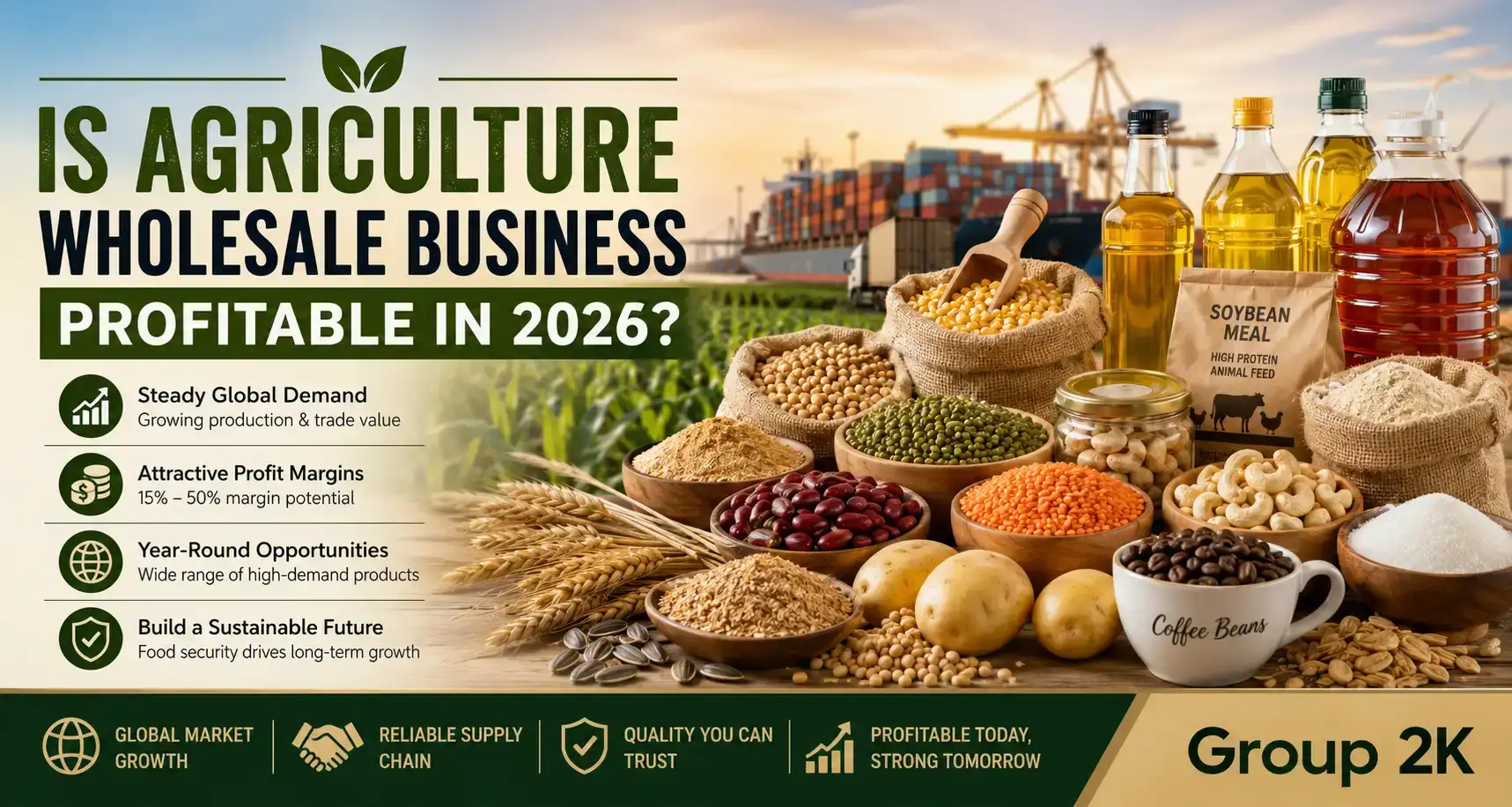
Global food demand keeps agriculture at the center of the wholesale trade conversation every year, and 2026 is no exception. Traders who compare sectors before committing capital often start with our full most profitable wholesale business guide for 2026, then narrow their focus once they see how grains, oilseeds, and pulses stack up against other categories.
This blog walks through the agriculture wholesale market from a single angle: real numbers. It covers the global production value, the margin range across grains, oils, and pulses, the specific products moving in high volume right now, and the risk factors that separate a steady trader from a struggling one. By the end, a reader should know exactly where agriculture fits their capital and risk appetite.
The short version is that agriculture remains profitable in 2026, but the depth of that profit depends heavily on product selection and sourcing discipline, not just sector choice.
The agriculture sector carries serious weight in the global economy. Gross production value in the agriculture market is projected to reach US$4.84 trillion in 2026, according to Statista Market Forecast. Analysts expect an annual growth rate of 3.82% through 2031, which would push the market to roughly US$5.84 trillion.
Trade volume tells a similar story. Import value in the global agriculture market is projected at US$1.05 trillion in 2026, with 3.17% annual growth expected through 2031. Export value sits close behind at US$985.02 billion, growing at 3.28% annually over the same period. These numbers confirm one thing clearly: cross-border agriculture trade is expanding steadily, year after year.
The wider agribusiness sector, which includes farm inputs, processing, storage, and wholesale distribution, tells an even bigger story. This sector was valued near US$4.7 trillion in 2024 and is expected to climb toward US$7.3 trillion by 2033, reflecting a 5.5% compound annual growth rate. A trader entering this space today steps into one of the largest and most stable trade sectors on earth.
Market conditions in 2026 remain mixed rather than one-directional. Input costs have eased in several agricultural categories compared to earlier peaks. Profitability still stays uneven because farmgate prices, freight rates, financing conditions, and export demand move at different speeds across regions. Buyers have also become more selective. Instead of cutting order volumes outright, they now choose suppliers who offer better pricing, better documentation, and better delivery reliability.
Currency strength plays a bigger role than most new traders expect. A weaker US dollar can reduce local-currency revenue for exporters, even when global commodity prices stay flat. Energy prices matter too. Diesel and logistics costs move directly with oil prices, and nitrogen fertilizer costs rise alongside them. Traders who track these macro signals protect their margins better than traders who focus only on the commodity price itself.
Profit margins in agriculture wholesale trading vary by product type, but a general benchmark applies across most commodity categories. Wholesale pricing typically carries a margin range between 15% and 50%, calculated through a cost-plus model that adds a target profit percentage on top of total acquisition cost. Commodity products with stable, high-volume demand tend to sit toward the lower end of that range, while specialty or processed agricultural goods can command higher margins.
| Investment Level | Typical Entry Point | Common Products |
|---|---|---|
| Small trader | Single container load | Pulses, beans, seeds |
| Mid-size distributor | Multiple container loads | Grains, oils, feed ingredients |
| Bulk exporter | Vessel-load contracts | Corn, soybeans, edible oils |
Return timelines in this business move faster than most industries. Commodity trading typically operates on 30 to 90 day cash cycles, since buyers purchase in bulk and payment terms stay short. This fast turnover makes agriculture attractive for traders who want their capital working continuously instead of sitting locked in long-term inventory.
Grain remains the backbone of global agriculture trade. Buyers purchase grain for two separate markets at once: human food production and animal feed manufacturing. This dual demand keeps grain trading active throughout the year, regardless of season.
Yellow corn sits at the center of this demand. Feed mills purchase it constantly for livestock nutrition, while food processors use it for milling and industrial applications. Many buyers specifically look for non-GMO yellow corn, since certified non-GMO status opens doors to premium export markets in Europe and parts of Asia.
Corn is not the only grain generating steady wholesale volume. White corn also holds a strong position in food-grade processing, where its natural, pure kernel quality makes it suitable for both domestic food manufacturing and export contracts.
A separate but equally important grain byproduct drives consistent demand in the feed industry. Wheat bran supplies high-fiber content to livestock feed formulations and bakery applications alike. Buyers sourcing this product in bulk typically look for natural wheat bran powder with consistent particle size and moisture control, since inconsistent quality directly affects feed conversion rates for livestock producers.
Edible oil trading represents one of the most consistently profitable segments within agriculture wholesale, largely because cooking oil demand does not fluctuate seasonally the way some raw commodities do.
Mustard oil holds a strong, established position in this category. Demand stays especially high across South Asian and Middle Eastern markets, where mustard oil is a staple cooking ingredient rather than a specialty product. Behind this finished oil sits its raw material market. Mustard seeds supply both oil extraction facilities and the spice trade, creating two separate revenue channels from a single crop.
The edible oil category extends well beyond mustard. Buyers regularly source refined soybean oil for large-scale food processing operations. Bakeries and snack manufacturers frequently request refined canola oil for its neutral flavor profile.
Sunflower-based oil carries its own dedicated buyer base as well. Import-heavy regions purchase refined sunflower oil in large volumes for household and food-service consumption. Peanut oil serves a more specialized frying-industry demand, where refined peanut oil delivers a high smoke point that fryers value.
Palm-based oils round out this segment with some of the highest trade volumes in the entire edible oil market. Crude palm oil feeds refineries around the world, while its processed form, RBD palm olein, supplies packaged cooking oil brands directly. Corn oil closes out the oil category, with refined corn oil sourced heavily by health-conscious cooking oil brands due to its lighter profile.
Pulses generate some of the fastest-moving volume in agriculture wholesale trade, largely because they combine long shelf life with year-round food industry demand.
Soybeans lead this category by a wide margin. They supply oil extraction plants, food processors, and animal feed manufacturers simultaneously, which spreads demand across three separate buyer types. Many international buyers specifically request non-GMO soybeans to meet certification requirements for premium food markets.
Bean and legume demand does not stop at soybeans. Green mung beans move quickly through food processing and sprouting industries, particularly across Asian and Middle Eastern markets where they appear in daily cooking. Buyers sourcing bulk volume usually look for fresh-stock green moong beans with consistent color and low moisture content.
Other pulses round out a diversified agriculture trading portfolio. Kidney beans remain a staple export item across red, white, and black varieties. Pinto beans hold steady demand in food processing and distribution channels. Red lentils and yellow split peas both carry consistent global export demand, since they store well and ship efficiently in bulk. Long-grain basmati rice adds a premium grain product to this segment, commanding stronger margins than standard rice varieties due to its export reputation.
Livestock feed manufacturing consumes an enormous volume of raw agricultural material every year, making it one of the most reliable demand sources for wholesale traders.
Soybean processing generates a valuable byproduct in this space. Soybean meal supplies high-protein nutrition to poultry and livestock operations worldwide, and demand for it often tracks closely with meat production growth. Forage products complete the feed picture. Alfalfa hay supplies cattle, horse, and rabbit feed markets, and remains one of the most requested forage products in bulk export contracts.
Oilseed byproducts add further depth to this category. Sunflower seeds supply both bird feed and oil extraction markets. Once oil extraction finishes, the remaining sunflower meal becomes a protein-rich feed ingredient in its own right. A similar pattern applies to safflower meal and cotton seed meal, both of which supply poultry and cattle feed formulations at competitive cost compared to soybean meal.
Fresh produce trading operates differently from grain and pulse trading, since shelf life directly limits how buyers plan their purchase cycles. Even so, certain fresh commodities generate consistent bulk demand throughout the year.
Potatoes represent one of the most traded fresh vegetables in wholesale agriculture. Russet potatoes supply food processing plants and food-service distributors due to their high starch content. Yukon gold potatoes serve a different buyer base, favored for their flavor and texture in retail and food-service markets.
Value-added agricultural exports round out a complete wholesale trading portfolio, often commanding stronger margins than raw commodity grain due to processing and grading requirements.
Cashew nuts hold strong demand in premium food markets, where grading quality directly determines price tier. Coffee beans supply roasters worldwide, with Arabica and Robusta varieties serving different segments of the roasting industry. Sugar closes out this category with one of the highest trade volumes globally. ICUMSA 45 sugar remains the benchmark grade for refined white sugar in international trade contracts.
Every profitable business carries risk, and agriculture wholesale trading is no exception. Currency fluctuation affects exporters directly. A weaker dollar reduces local-currency earnings even when commodity prices stay stable in international terms. Freight and logistics costs add another layer of risk, since diesel prices move fertilizer costs and shipping rates at the same time.
Commodity price volatility remains a constant factor across grains, oils, and pulses alike, driven by weather patterns, planting decisions, and geopolitical events. Storage and quality degradation pose a real risk for traders holding physical inventory, particularly with fresh produce and moisture-sensitive grains. Trade policy changes, including tariffs and import quotas, can shift market access with little warning. Traders who diversify across multiple product categories, rather than depending on a single commodity, generally absorb these risks better than traders who concentrate all capital in one product line.
Agriculture wholesale trading suits several different trader profiles. New entrants with limited capital often start with pulses or beans, since these products carry lower per-container cost and stable, predictable demand. Existing distributors looking to expand their portfolio typically add grain and edible oil lines, since these products move in higher volume and generate stronger repeat business. Established exporters with strong logistics networks tend to focus on high-volume commodities like corn, soybeans, and palm oil, where margin per unit stays smaller but total transaction volume drives overall profit.
| Category | Typical Margin Range | Demand Trend | Risk Level |
|---|---|---|---|
| Grains (corn, wheat bran) | 10-20% | Stable, feed-driven | Medium |
| Edible oils | 15-25% | Stable, consumption-driven | Medium |
| Pulses and legumes | 15-30% | Growing, export-driven | Medium-Low |
| Animal feed ingredients | 10-20% | Growing with livestock sector | Medium |
| Fresh produce | 20-35% | Seasonal | High |
| Nuts, coffee, sugar | 20-40% | Stable to growing | Medium |
Supplier selection determines profit margin as much as market timing does. A few checkpoints separate a dependable sourcing partner from a risky one.
Quality certification matters first. Documentation gaps can delay shipments at customs and create disputes with downstream buyers over grade discrepancies. Bulk supply capacity comes next, since inconsistent volume availability disrupts production schedules for food manufacturers and feed mills who depend on predictable delivery. Export documentation experience also carries weight. A supplier familiar with phytosanitary certificates and customs paperwork moves shipments faster and avoids costly delays. Pricing transparency rounds out the checklist, since factory-direct pricing protects trader margin from hidden intermediary markups.
Agriculture wholesale trading holds real, lasting profit potential in 2026, backed by a global market that keeps expanding past the multi-trillion-dollar mark year after year. Foundational staples such as yellow corn, wheat bran, and raw grains offer dependable, high-volume turnover with predictable cash cycles, and traders who need steady, repeatable income tend to build their base here first. Value-added commodities like refined edible oils, pulses, and packaged nuts push margins meaningfully higher, rewarding traders who invest time in grading, certification, and buyer relationships rather than chasing raw commodity volume alone.
None of this profit arrives automatically. Currency swings, freight cost spikes, and inventory degradation can erode margin quickly for a trader who ignores them, which is why diversification across grain, oil, pulse, and value-added categories matters as much as picking the right product on day one. A trader who pairs steady-demand staples with higher-margin specialty goods, while staying disciplined about supplier verification, builds a resilient agriculture trading business that can absorb regional shocks without losing its footing.
Group 2K connects commercial buyers directly with verified global agricultural exporters, giving traders access to high-demand grains, pulses, and refined cooking oils at factory-direct pricing. Every shipment moves through checked documentation and quality benchmarks, so a trader spends less time chasing paperwork and more time closing deals.
Whether the plan involves a first single-container shipment or a scaled, multi-product distribution contract, a verified supply chain remains the foundation of long-term commercial growth. Get in touch with our team today to build an agriculture sourcing plan that matches your budget and target markets.
Every household on earth eventually replaces a refrigerator, a washing machine, or a hair styling
READ FULLA structural panel and a warehouse pallet come from the same raw material, yet they serve two com
READ FULLCold-climate households still need heat, and power plants across Europe and Asia still need renew
READ FULL